ERGIN ÇAVUŞOĞLU
/
PALMA GIOVANE
Hatton Gallery, Newcastle University (2024)
Curated by Alistair Robinson
The first of a sequence of three exhibitions collectively titled ‘About suffering, they were never wrong’, with international contemporary art and ‘old masters’ from the Hatton Gallery collection.
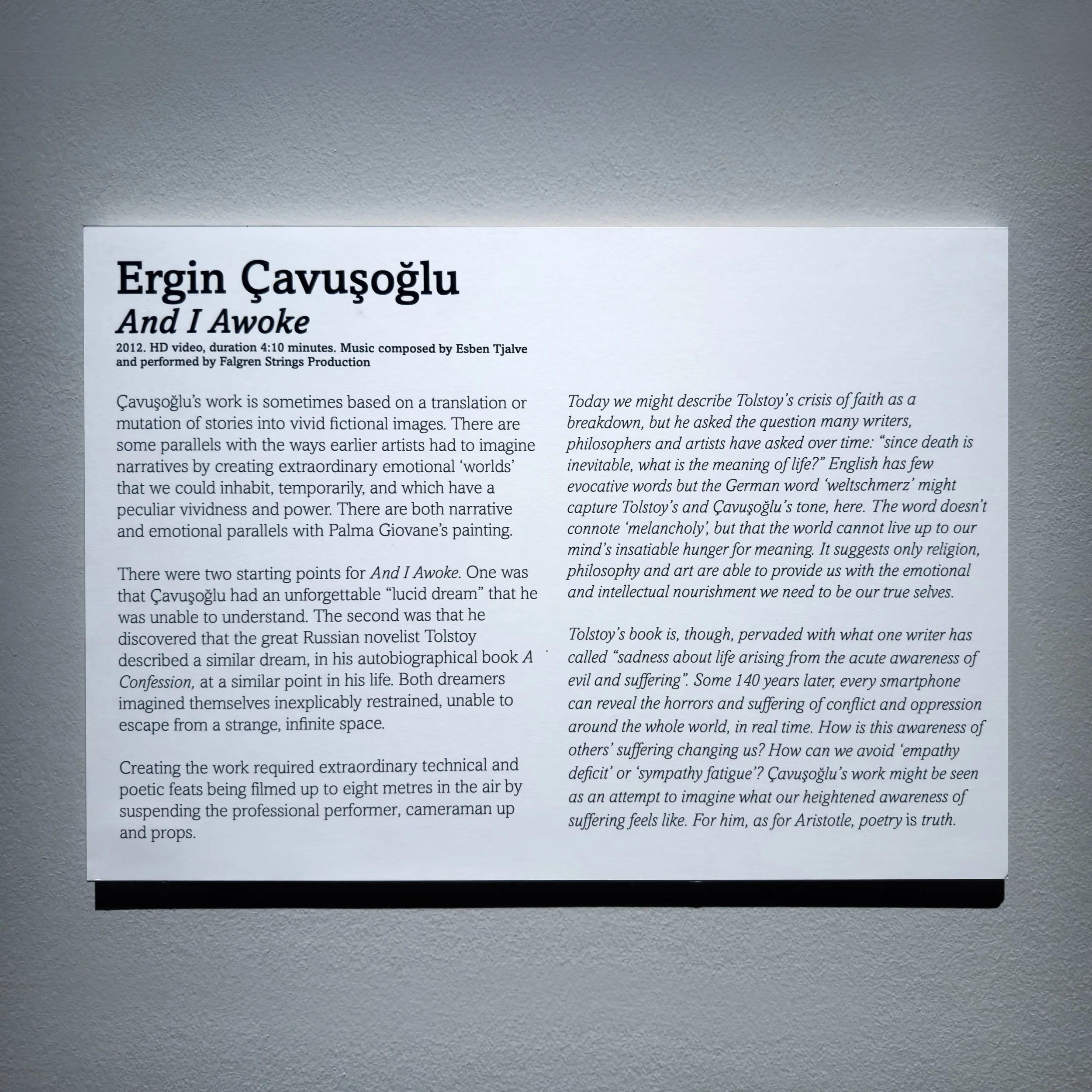
Ergin Çavuşoğlu
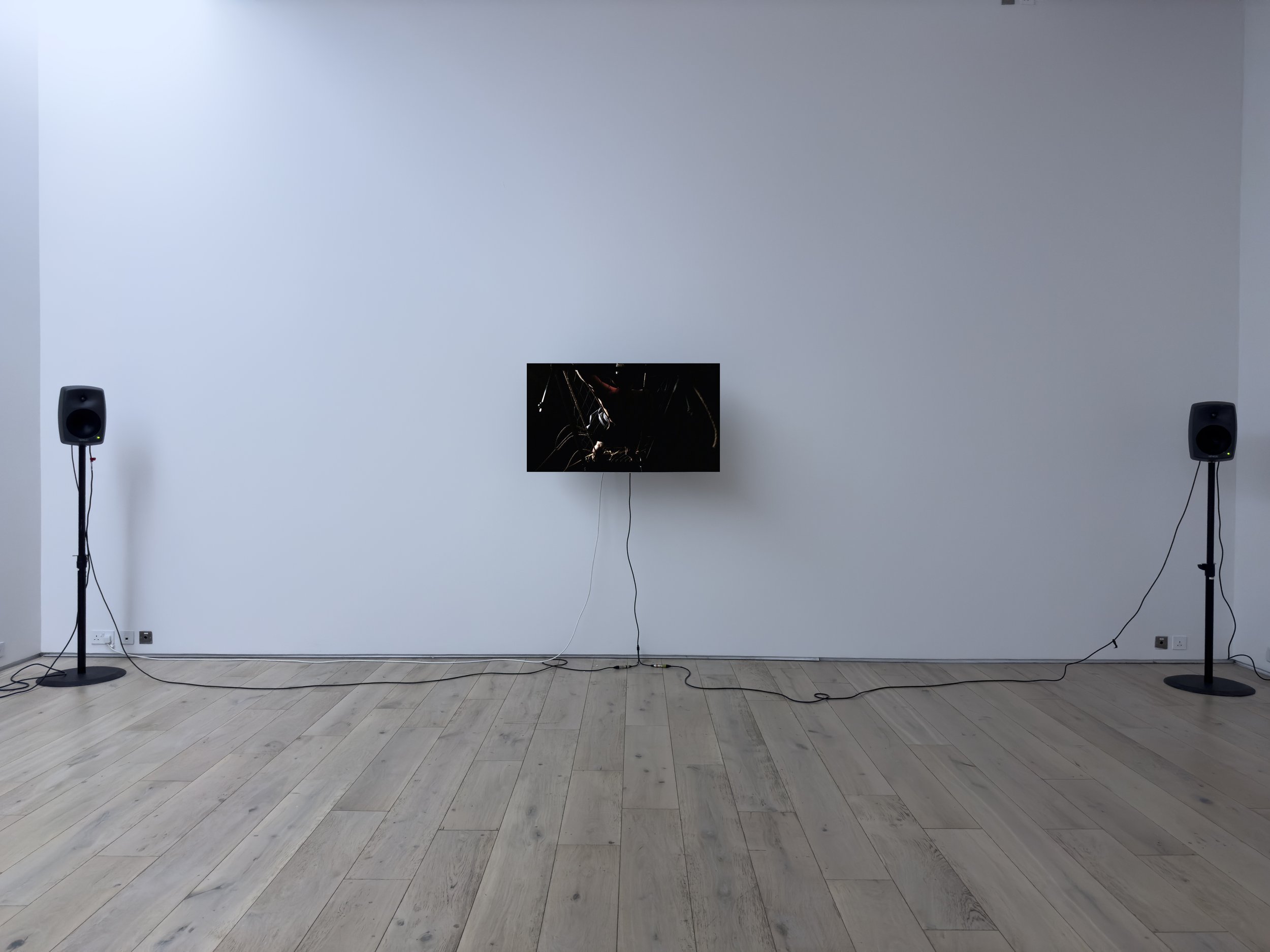
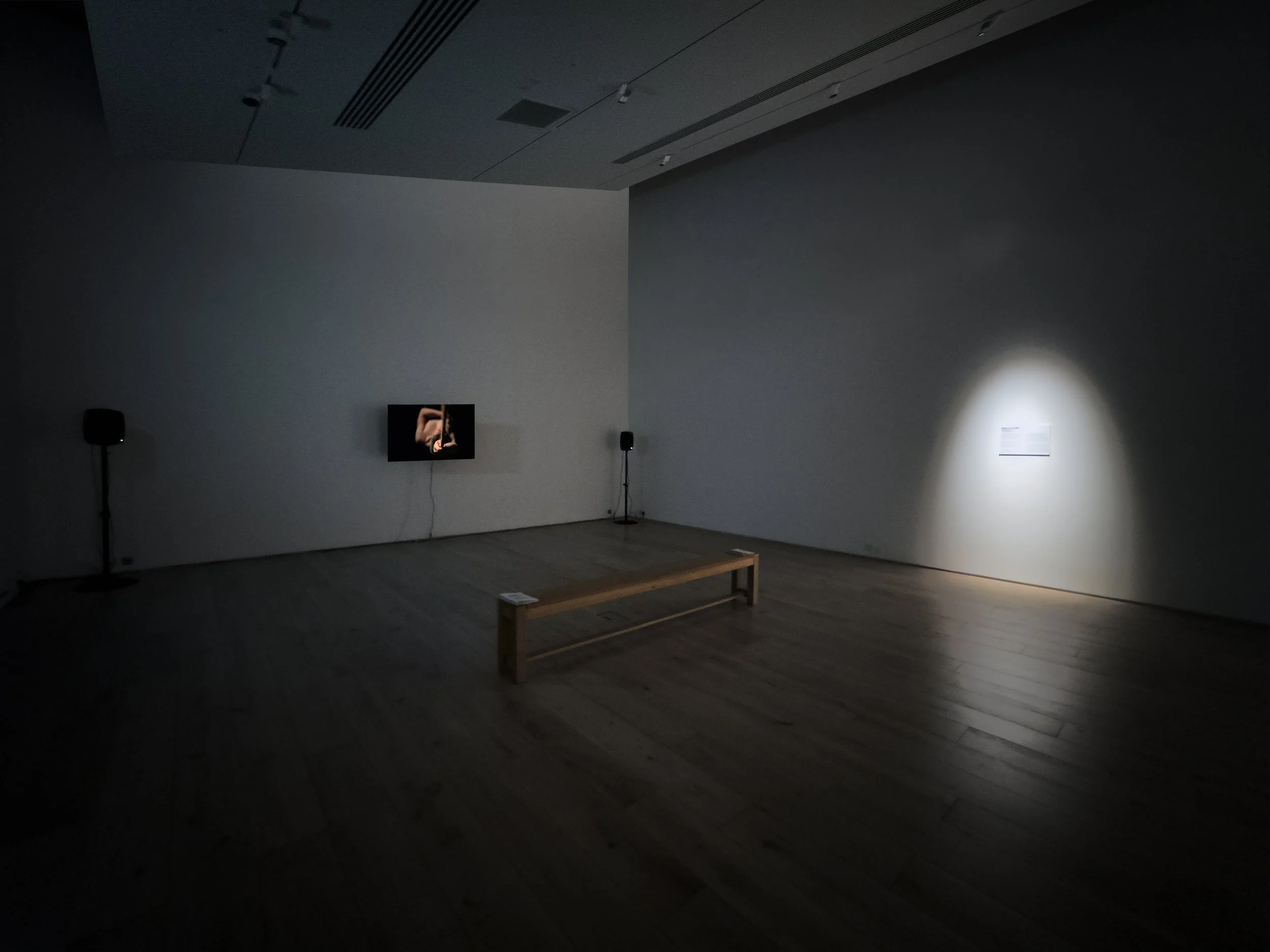
And I Awoke
2012. HD video, duration 4:10 minutes. Music composed by Esben
Tjalve & performed by Falgren Strings Production
Çavuşoğlu’s work is sometimes based on a translation or mutation of stories into vivid fictional images. There are some parallels with the ways earlier artists had to imagine narratives by creating extraordinary emotional ‘worlds’ that we could inhabit, temporarily, and which have a peculiar vividness and power. There are both narrative and emotional parallels with Palma Giovane’s painting. There were two starting points for And I Awoke. One was that Çavuşoğlu had an unforgettable “lucid dream” that he was unable to understand. The second was that he discovered that the great Russian novelist Tolstoy described a similar dream, in his autobiographical book A Confession, at a similar point in his life. Both dreamers imagined themselves inexplicably restrained, unable to escape from a strange, infinite space. Creating the work required extraordinary technical and poetic feats, being filmed eight metres into the air with a professional performer. The music is specially composed and performed.
Today we might describe Tolstoy’s crisis of faith as a breakdown, but he asked the question many writers, philosophers and artists have asked over time: “since death is inevitable, what is the meaning of life?” English has few evocative words but the German word ‘weltschmerz’ might capture Tolstoy’s and Çavuşoğlu’s tone, here. The word doesn’t connote ‘melancholy’, but that the world cannot live up to our mind’s insatiable hunger for meaning. It suggests only religion, philosophy and art are able to provide us with the emotional and intellectual nourishment we need to be our true selves. called “sadness about life arising from the acute awareness of Tolstoy’s book is, though, pervaded with what one writer has evil and suffering”. Some 140 years later, every smartphone can reveal the horrors and suffering of conflict and oppression around the whole world, in real time. How is this awareness of others’ suffering changing us? How can we avoid ‘empathy deficit’ or ‘sympathy fatigue’? Çavuşoğlu’s work might be seen as an attempt to imagine what our heightened awareness of suffering feels like. For him, as for Aristotle, poetry is truth.
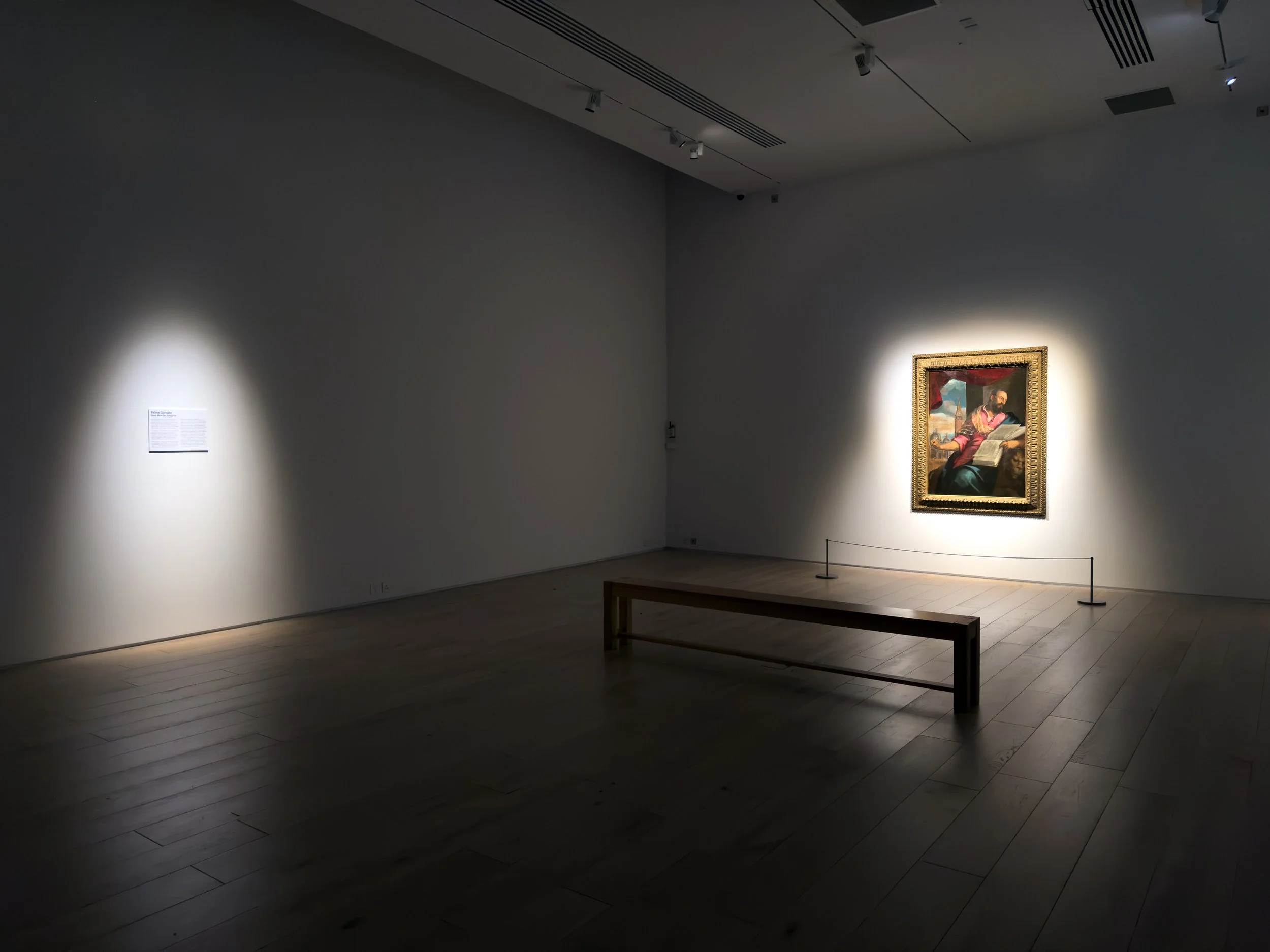
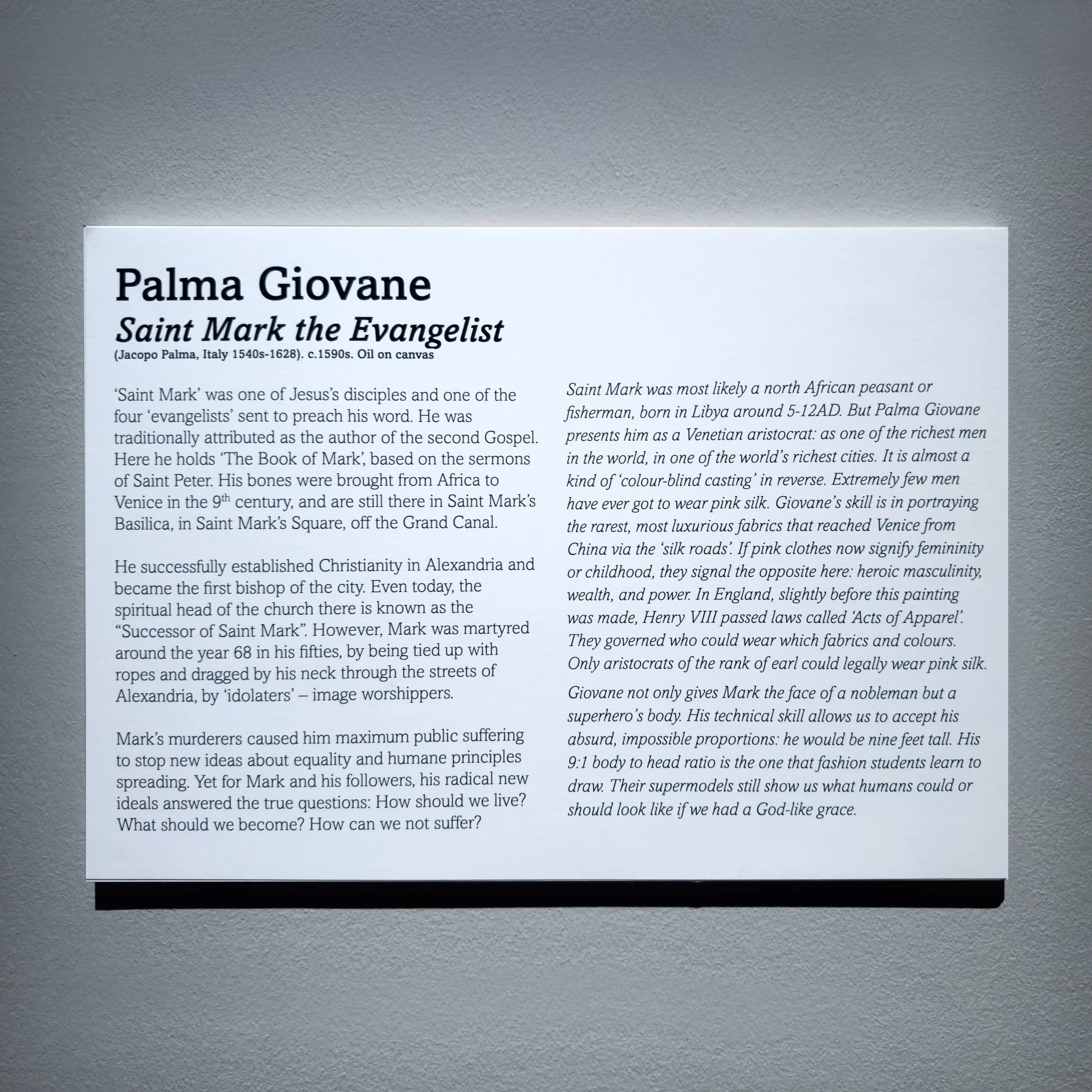
Palma Giovane
Saint Mark the Evangelist
(Jacopo Palma, Italy 1540s-1628). c.1590s. Oil on canvas
‘Saint Mark’ was one of Jesus’s disciplines, and one of the four ‘evangelists’ sent to preach his word. He was traditionally attributed as the author of the second Gospel. Here he holds ‘The Book of Mark’, based on the sermons of Saint Peter. His bones were brought from Africa to Venice in the 9th century, and are still there in Saint Mark’s Basilica, in Saint Mark’s Square, off the Grand Canal. He successfully established Christianity in Alexandria, and became the first bishop of the city. Even today, the spiritual head of the church there is known as the “Successor of Saint Mark”. However, Mark was martyred around the year 68 in his fifties, by being tied up with ropes and dragged by his neck through the streets of Alexandria, by ‘idolators’ – image worshippers. Mark’s murderers caused him maximum public suffering to stop new ideas about equality and humane principlesspreading. Yet for Mark and his followers, his radical new ideals answered the true questions: How should we live? What should we become? How can we not suffer?
Saint Mark was most likely a north African peasant or fisherman, born in Libya around 5-12AD. In a kind of ‘colour-blind casting’, Palma Giovane presents him as a Venetian aristocrat: as one of the richest men the world, in one of theworld’s richest cities. Very few men have ever got to wear pink silk. Giovane’s skill is in portraying the rarest, most luxurious fabrics that reached Venice from China via the ‘silk roads’. If pink clothes now signify femininity or childhood, they signal the opposite here: heroic masculinity, wealth and power. In England, slightly before this painting was made, Henry VIII passed laws called ‘Acts of Apparel’. They governed who could wear which fabrics and colours. Only aristocrats of the rank of earl could legally wear pink silk.
Giovane not only gives Mark the face of a nobleman but a superhero’s body. His technical skill allows us to accept hisabsurd, impossible proportions: he would be nine feet tall. His 9:1 body to head ratio is the one that fashion students learn to draw. Their supermodels still show us what humans could or should look like, if we had a God like grace.